
Why Fast?
Many of you have probably at least heard of fasting. Popular diet and healthy living promoters might even recommend a fast like the Daniel Fast or Intermittent Fasting to lose weight or reset your body by eating clean. But fasting has been around and practiced for centuries. In fact almost every major religion has a practice of fasting.
In the Bible, fasting had less to do with a healthy lifestyle and more to do with prayer, petition, confession, repentance, and communion with God. It was less about the health of our bodies as it was connecting and listening to Yahweh. It was a way for people to abstain from food or drink or both in order to spend dedicated and intimate time with God.
Types of Fasting
Before we get into some of the reasons that the people of God would fast, let's explore the different types of fasting that are commonly practiced today.
Partial Fast
Certain types of food or something specific (i.e. dairy, meat, chocolate, sweets, soda, etc.) is given up for a period of time. This is typically the type of fast that many practice during the 40 days of Lent.
One example of a partial fast is in Daniel 10:2-3, “In those days I, Daniel, was mourning for three weeks. I ate no delicacies, no meat or wine entered my mouth, nor did I anoint myself at all, for the full three weeks.”
Normal Fast
All solid foods are withheld. Only water and/or juice are consumed during a complete fast.
Total Fast
These fasts consist of not eating or drinking anything at all for a period of time. Total fasts are not typically recommended for longer than 3 days and should be done carefully.
An example we see of a total fast is in Acts after Paul encounters the Lord. It says, “For three days he was blind, and did not eat or drink anything.” We also read in Esther 4:16, “Go, gather all the Jews to be found in Susa, and hold a fast on my behalf, and do not eat or drink for three days, night or day. I and my young women will also fast as you do. Then I will go to the king, though it is against the law, and if I perish, I perish.”
Reasons for Fasting
Now that we have talked about the different types of fasting in Scripture, let's explore the different reasons that we see people fasting in the Bible. There seems to be three main reasons for fasting in Scripture.
Confession
Probably the most recognizable examples of people fasting in the Bible is when they are confessing and repenting from sin. We see many instances in the Old Testament where people recognize their rebellion and sin and plead with the Lord for forgiveness. We see a whole people group recognize their rebellion through prophets, prophets interceding on the behalf of God’s people, and individuals recognizing their own individual sin. In all of these their response is taking a posture of humility by confessing and repenting through fasting and prayer. Fasting in times of confession and repentance here seems to be a physical denial of food in order to express an inward denial of idols. Here are just a few examples of God’s people fasting as a posture of confession and repentance from their sin.
“Now on the twenty-fourth day of this month the people of Israel were assembled with fasting and in sackcloth, and with earth on their heads. And the Israelites separated themselves from all foreigners and stood and confessed their sins and the iniquities of their fathers.” Nehemiah 9:1-2
“So I turned my attention to the Lord God to seek him by prayer and petitions, with fasting, sackcloth, and ashes. I prayed to the Lord my God and confessed…” Daniel 9:3-4a
“Even now— this is the Lord’s declaration— turn to me with all your heart, with fasting, weeping, and mourning.” Joel 2:12
“Then the people of Nineveh believed God. They proclaimed a fast and dressed in sackcloth—from the greatest of them to the least.” Jonah 3:5
“So they gathered at Mizpah and drew water and poured it out before the Lord and fasted on that day and said there, “We have sinned against the Lord.” And Samuel judged the people of Israel at Mizpah.” 1 Samuel 7:6
Lament
Fasting was not just an inward focus on sin and repentance. The people of God, through fasting and prayer, would grieve, lament, or mourn the death, sickness, or oppression they were experiencing. They would recognize their outward circumstances and turn to God with fasting and prayer and plead to Him to hear their cries. Here are some examples we see of this type of fasting and prayer:
“...all their brave men set out and retrieved the body of Saul and the bodies of his sons and brought them to Jabesh. They buried their bones under the oak[a] in Jabesh and fasted seven days.” 1 Chronicles 10:12
“They mourned, wept, and fasted until the evening for those who died by the sword—for Saul, his son Jonathan, the Lord’s people, and the house of Israel.” 2 Samuel 1:12
“There was great mourning among the Jewish people in every province where the king’s command and edict reached. They fasted, wept, and lamented, and many lay in sackcloth and ashes.” Esther 4:3
“Yet when they were sick, my clothing was sackcloth; I humbled myself with fasting, and my prayer was genuine. I went about mourning as if for my friend or brother; I was bowed down with grief, like one mourning for a mother.” Psalm 35:13-14
Guidance and Blessing
Finally, there is a third reason we see the people of God fasting in scripture. Not only do we see people fasting and praying to confess and repent of sin, or to mourn and lament what is happening to or around them, but they also fast and pray to seek guidance and/or a kind of future blessing from God. In the other examples of fasting, the people would fast and pray to confess or lament. These were examples of the people responding to their sin or their circumstances. But in these examples of fasting and praying, the people are asking for God to respond. They are listening, waiting, and pleading for a response from God so that they would know how to move forward or for blessings of protection as they moved forward. Here are some of those examples.
“Our God, will you not judge them? For we are powerless before this vast number that comes to fight against us. We do not know what to do, but we look to you.” 2 Chronicles 20:12 - King Jehoshaphat
“The whole Israelite army went to Bethel where they wept and sat before the Lord. They fasted that day until evening and offered burnt offerings and fellowship offerings to the Lord. Then the Israelites inquired of the Lord.” Judges 20:26-27
“I proclaimed a fast by the Ahava River, so that we might humble ourselves before our God and ask him for a safe journey for us, our dependents, and all our possessions.” Ezra 8:21
“Then the king went to his palace and spent the night fasting. No diversions were brought to him, and he could not sleep.” Daniel 6:18 -King Darius fasting for God to save Daniel in the lion's den.
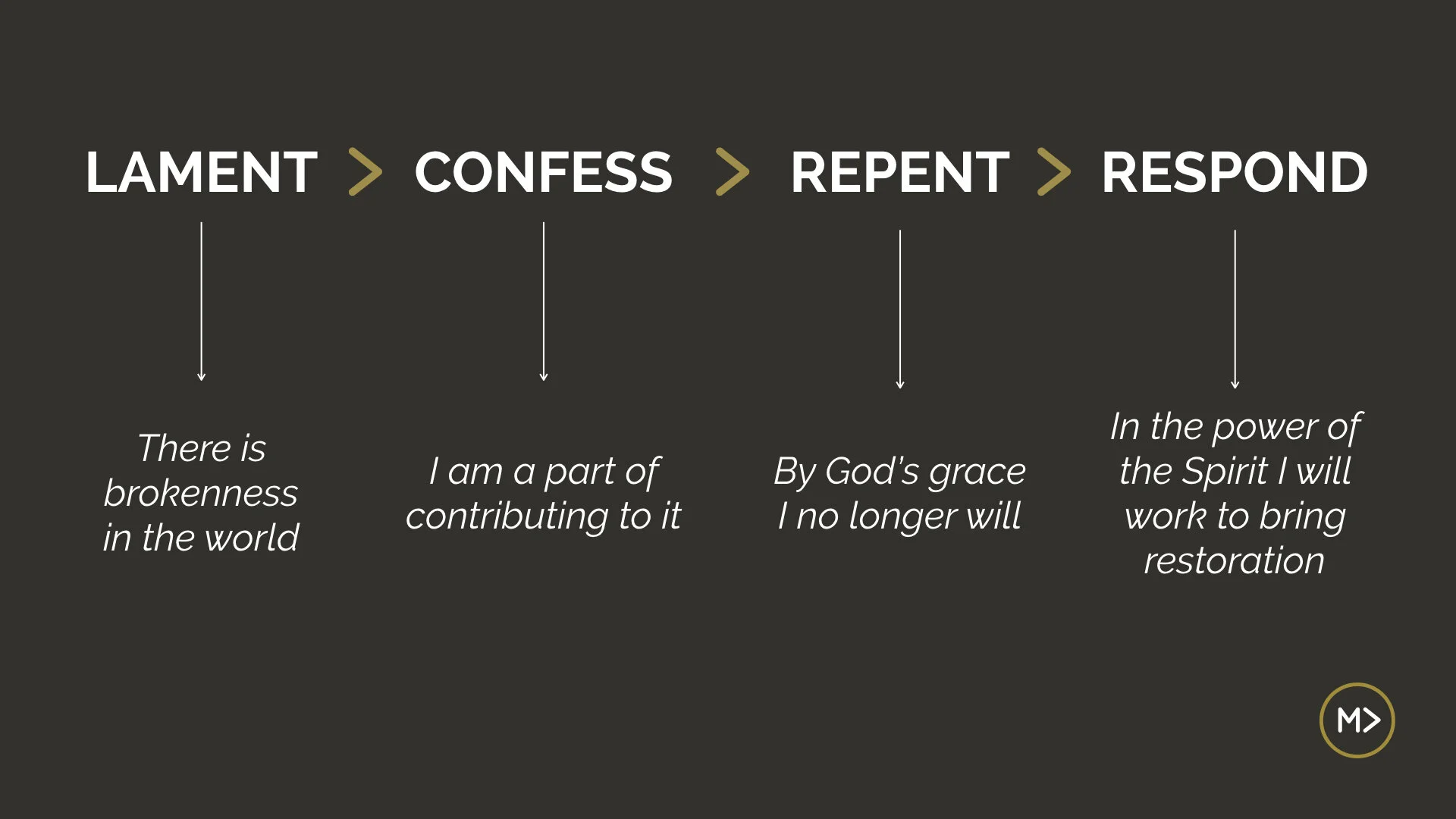
You might have seen this graphic recently. Missio Dei Communities has shared this as a helpful tool for the people of God to process and respond to issues of race in our communities. As you can see, these are all postures that are connected to fasting and praying in the Bible. Let us not lose sight that this was a normal response for the people of God in Scripture. As we move through each of these postures, may we take the time to fast and pray.
As we lament the sin of racism in our world, may we fast and pray.
As we confess how we have contributed to the systems and powers of racism in our world, may we fast and pray.
As we repent and turn from our ways, may we fast and pray.
As we seek the Spirit of God for guidance on how to bring restoration and healing to this brokenness, may we fast and pray.